
The science
Muscle, protein and age, explained.
How the body uses protein, what changes with age, and why nutrition matters.
Strength is checked first.
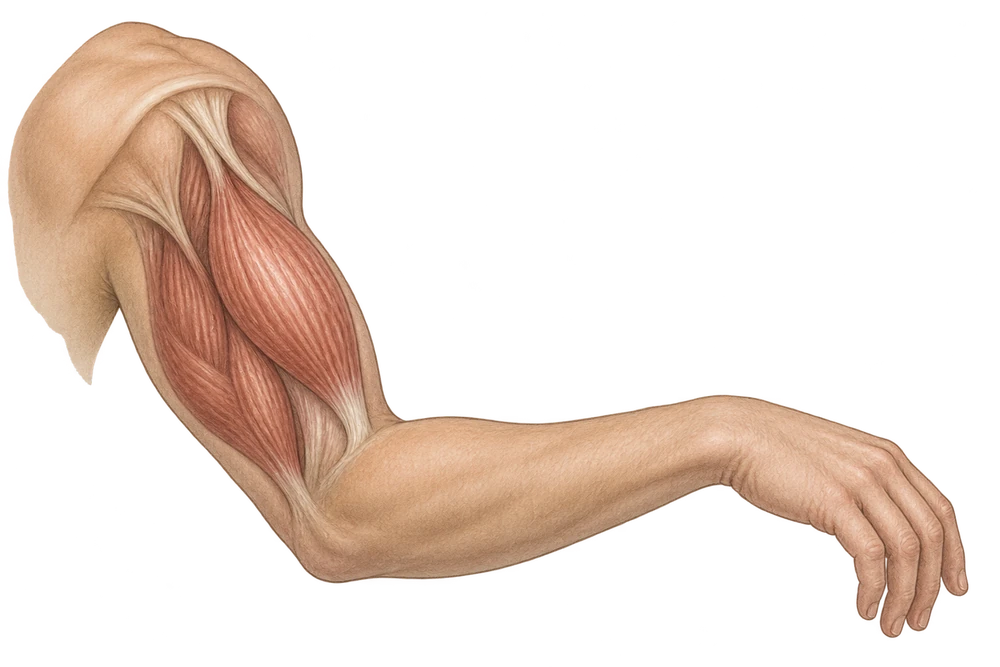
Sarcopenia means low muscle strength, confirmed by low muscle quantity or quality. Strength is checked first; physical performance shows how severe it is.
Evidence and sources
Sarcopenia is the clinical name for losing muscle strength, confirmed by low muscle quantity or quality.1 Clinicians look at strength first because it is the better predictor: the European consensus puts low strength at the center of the definition because it predicts poor outcomes better than muscle mass does.1 In the long Health ABC study, strength also declined faster than muscle mass.2
It is common, but it is not the norm: estimates for adults aged 60 and over range from roughly 10 to 27 percent, depending on the definition used, so most older adults do not have it.3 It is not inevitable: aging, illness, inactivity and poor nutrition all contribute, and the last two can be changed.1 5
How clinicians look at it, in order. Low strength on a simple test, such as grip or rising from a chair five times, is the first thing checked. A measure of muscle quantity or quality confirms it. Low physical performance, such as gait speed, marks it as severe.
The steps follow the European consensus definition (EWGSOP2). They are a way of looking, not a verdict: strength can often be rebuilt.
In everyday terms, strength shows up in ordinary things first: standing up, the stairs, carrying, recovering after an illness. Noticing those changes early, and mentioning them, is where a proper assessment starts.
Roughly 10 to 27 in every 100
adults aged 60 and over meet a definition of sarcopenia, depending on the definition used. Most do not.
Estimates vary with the definition used.
Protein from food helps maintain muscle.
Protein supplies the building blocks your body uses to maintain muscle.
Movement helps keep muscle responsive to protein.
Evidence and sources
Protein is digested into amino acids. Nine of them are essential: the body cannot make them, so they have to come from food. Leucine, one of the nine, also acts as a signal that starts the building process.6 7 Physical activity keeps muscle responsive to the protein that arrives.4 7
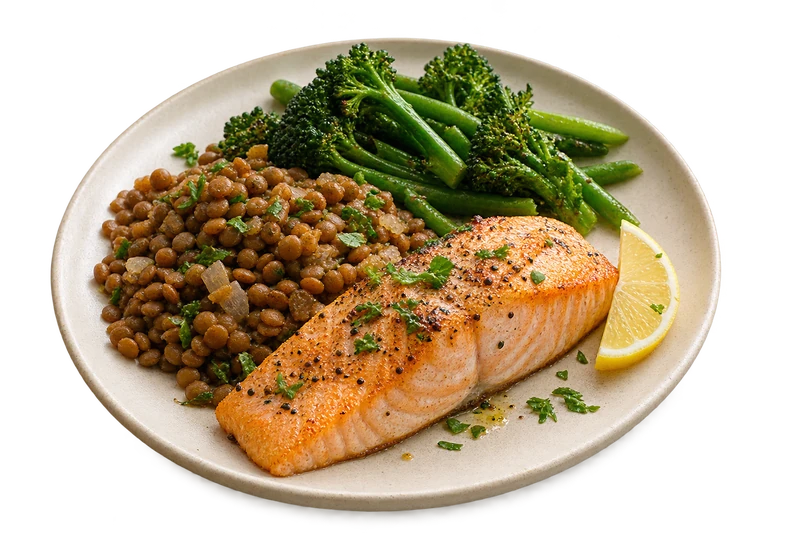
Digestion releases amino acids
For clinicians: the pathway in more detail
Dietary protein → digestion → the amino-acid pool, with the nine essential amino acids as substrate for myofibrillar protein synthesis; leucine additionally acts through mTORC1 signaling; resistance exercise sensitizes muscle to amino acids.6 7 Expert groups recommend adequate daily protein for older adults, set to the individual, together with physical activity.4 5
How the muscle response changes with age.
With age, muscle can become less responsive to protein. Enough good-quality protein, matched to the person’s needs, and regular movement support muscle maintenance.
Evidence and sources
In laboratory studies comparing healthy older and younger adults, older muscle responded less to the same amount of protein. Researchers call this anabolic resistance.6 7 It is a general pattern seen across studies, not a rule for any one person, and it does not mean every older adult needs a special protein.
What follows from it is practical: enough good-quality protein each day, matched to the person’s needs, and staying active matter more with age.4 5 Analyses of older adults living at home find that many eat less protein than guidelines recommend.8
The meal is the same. The rebuilding response it produces is quieter. That is why expert groups advise more protein per day, by body weight, for older adults than for younger adults, with more again during illness, together with physical activity.
For some older adults, everyday food alone no longer covers those needs. Medical nutrition is designed to help close that gap, under a clinician's supervision.
For clinicians: the guideline figures
PROT-AGE recommends an average daily intake of 1.0 to 1.2 g protein per kg body weight for healthy older adults and 1.2 to 1.5 g/kg per day for older adults with acute or chronic illness, together with physical activity; older adults with severe kidney disease who are not on dialysis are the exception and need individual advice.4 ESPEN's geriatric guideline gives compatible advice and places nutrition within a wider assessment of the person.5 In laboratory dose-response work, healthy older men needed a greater relative protein dose in a single meal than younger men to maximize muscle protein synthesis.6 Pooled cohort data suggest a sizeable share of community-dwelling older adults fall below the daily figures.8 These are population guidelines; individual needs are assessed by a clinician.
The evidence for whey protein, HMB and vitamin D.
The first CORUS product combines whey protein, HMB and vitamin D in an unflavored powder.
Evidence and sources
The first CORUS product brings together whey protein, HMB and vitamin D in an unflavored powder. For each, the finding below is what studies of the ingredient, or of related formulations, have shown in older adults, with the limits stated. None of these studies tested CORUS itself.
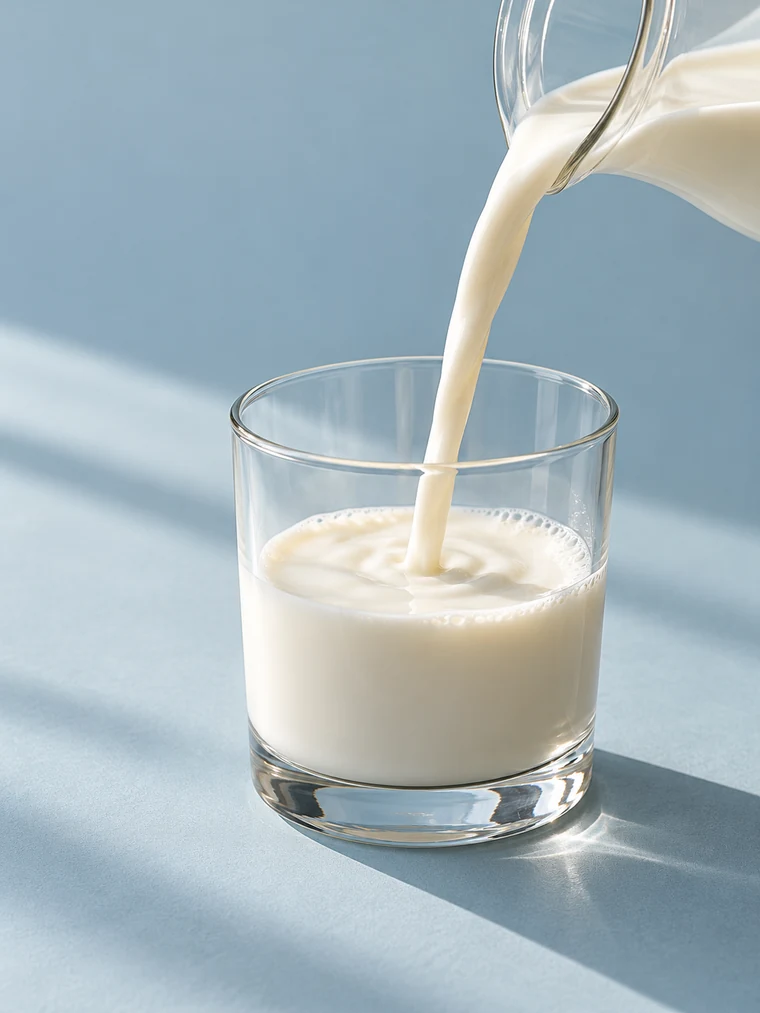
Whey proteinComplete, fast-digesting milk protein
A complete milk protein that supplies all nine essential amino acids, including leucine.
Evidence and sources
Whey supplies all nine essential amino acids and is naturally rich in leucine, the one that also carries the signal to build.6 7 Its largest fraction, beta-lactoglobulin, is especially rich in leucine and the other essential amino acids.
Expert groups recommend enough protein each day for older adults, set to the individual.4 In a laboratory study, healthy older men needed more protein in a single meal than younger men to stimulate muscle protein synthesis fully.6
Limits: the per-meal response was measured in healthy men in laboratory settings; it describes a pattern, not a threshold for an individual.
Moore DR et al., 2015Dose-response study · healthy older and younger men
- Design
- Laboratory dose-response study of myofibrillar protein synthesis after graded protein doses, comparing healthy older and younger men.
- Found
- Older men required a greater relative protein intake per meal to maximally stimulate muscle protein synthesis.
- Did not show
- A universal threshold, a clinical outcome, or anything about a finished product.
- Source
- DOI · source 6
Bauer J et al., PROT-AGE, 2013Position paper · expert study group
- Design
- Evidence review and consensus recommendations on dietary protein for older people.
- Found
- Recommends higher daily protein intakes per kg body weight for older adults than for younger adults, higher again in illness, with physical activity; severe kidney disease not on dialysis is the exception.
- Did not show
- A trial result; it is guidance, not an outcome study.
- Source
- DOI · source 4
HMBβ-hydroxy-β-methylbutyrate
A compound the body makes from leucine, studied for its role in preserving muscle mass.
Evidence and sources
A compound the body makes in small amounts from leucine. In older adults it has been studied mainly for its effect on muscle breakdown and muscle mass: a 2015 meta-analysis of body-composition outcomes found HMB associated with preserved muscle mass.9
On function the picture is unsettled. An umbrella review of 15 systematic reviews found none reporting better physical function, and inconsistent findings for mass and strength;10 a newer meta-analysis of 21 trials in 1,935 adults over 50 pooled small improvements in muscle mass, grip strength, gait speed and chair-stand time, but not in six-minute walk distance; populations, settings and doses varied, some trials combined HMB with exercise or other nutrients, and heterogeneity was considerable.15
Limits: trials are small, populations and settings vary, and one of the larger studies combined HMB with vitamin D and exercise, so its result cannot be attributed to HMB alone.13 14
Wu H et al., 2015Systematic review and meta-analysis · older adults · body composition
- Design
- Pooled randomized trials of HMB supplementation in older adults; outcomes were body-composition measures.
- Found
- HMB was associated with preservation of muscle mass compared with control.
- Did not establish
- A benefit for strength or physical function; those outcomes were outside the scope of this review.
- Source
- DOI · source 9
Phillips SM et al., 2022Umbrella review · 15 systematic reviews of HMB
Li et al., 2025Meta-analysis · 21 trials, 1,935 adults over 50
- Design
- Pooled randomized trials of oral HMB supplementation in people over 50.
- Found
- Small pooled improvements in lean and appendicular muscle mass, grip strength, gait speed and five-time chair-stand time; no clear change in six-minute walk distance.
- Did not show
- An effect for any one person, or for the CORUS formula, which no included trial tested. Populations, settings, doses and co-interventions varied, and heterogeneity was considerable.
- Source
- DOI · source 15
Deutz NE et al., 2013Randomized trial · 24 older adults, 19 evaluable, 10 days of bed rest
Rathmacher JA et al., 2020Randomized trial · 238 enrolled, 117 completed per-protocol, over 60 with insufficient vitamin D · 12 months
- Design
- HMB plus vitamin D3, with or without resistance training, over 12 months.
- Found
- Some functional benefit in participants who did not exercise.
- Did not show
- Added benefit in the exercising group; and the intervention combined HMB with vitamin D, so the result is not HMB alone.
- Source
- PubMed · source 14
Vitamin DA nutrient with a role in muscle function
A nutrient involved in normal muscle function.
Evidence and sources
A 2014 meta-analysis of randomized trials found a small positive effect of vitamin D supplementation on muscle strength, larger in people who started with low levels, and no effect on muscle mass or power.12 A larger 2022 systematic review and meta-analysis of vitamin D used on its own found no significant improvement in muscle strength, muscle mass or physical performance in older adults.16
Vitamin D has also been studied together with protein. In the PROVIDE trial of a related formula, a vitamin D and leucine-enriched whey supplement improved chair-stand time and appendicular muscle mass in sarcopenic older adults over 13 weeks compared with an isocaloric control.11
Limits: PROVIDE tested a specific product with its own composition; its results describe that product, not CORUS. Handgrip strength and the overall performance battery did not differ between groups.11
Beaudart C et al., 2014Systematic review and meta-analysis · randomized trials
Prokopidis K et al., 2022Systematic review and meta-analysis · vitamin D alone · older adults
- Design
- Pooled randomized trials of vitamin D monotherapy and measures of sarcopenia in community-dwelling older adults.
- Found
- No significant effect of vitamin D alone on muscle strength, muscle mass or physical performance.
- Did not show
- A benefit from vitamin D given without protein or exercise; a null finding set against the smaller positive effect Beaudart 2014 reported.
- Source
- DOI · source 16
Bauer JM et al., PROVIDE, 2015Related-formula trial · randomized, double-blind · 380 sarcopenic older adults · 13 weeks
- Design
- Vitamin D and leucine-enriched whey protein supplement versus an isocaloric control, twice daily.
- Found
- Greater improvement in chair-stand time and in appendicular muscle mass in the intervention group.
- Did not show
- A difference in handgrip strength or in the short physical performance battery between groups; and the product tested is not CORUS.
- Source
- DOI · source 11
05 · Sources
References.
- 1Definition Cruz-Jentoft AJ et al. Sarcopenia: revised European consensus on definition and diagnosis. Age and Ageing, 2019. DOI
- 2Cohort study Goodpaster BH et al. The Loss of Skeletal Muscle Strength, Mass, and Quality in Older Adults: The Health, Aging and Body Composition Study. J Gerontol A Biol Sci Med Sci, 2006. DOI
- 3Prevalence review Petermann-Rocha F et al. Global prevalence of sarcopenia and severe sarcopenia: a systematic review and meta-analysis. J Cachexia Sarcopenia Muscle, 2022. DOI
- 4Guideline Bauer J et al. Evidence-Based Recommendations for Optimal Dietary Protein Intake in Older People: A Position Paper From the PROT-AGE Study Group. J Am Med Dir Assoc, 2013. DOI
- 5Guideline Volkert D et al. ESPEN practical guideline: Clinical nutrition and hydration in geriatrics. Clinical Nutrition, 2022. DOI
- 6Dose-response study Moore DR et al. Protein Ingestion to Stimulate Myofibrillar Protein Synthesis Requires Greater Relative Protein Intakes in Healthy Older Versus Younger Men. J Gerontol A Biol Sci Med Sci, 2015. DOI
- 7Review Breen L, Phillips SM. Skeletal muscle protein metabolism in the elderly: Interventions to counteract the ‘anabolic resistance’ of ageing. Nutrition & Metabolism, 2011. DOI
- 8Intake analysis Hengeveld LM et al. Prevalence of protein intake below recommended in community-dwelling older adults: a meta-analysis across cohorts from the PROMISS consortium. J Cachexia Sarcopenia Muscle, 2020. DOI
- 9Ingredient meta-analysis Wu H et al. Effect of beta-hydroxy-beta-methylbutyrate supplementation on muscle loss in older adults: A systematic review and meta-analysis. Arch Gerontol Geriatr, 2015. DOI
- 10Umbrella review Phillips SM et al. An umbrella review of systematic reviews of β-hydroxy-β-methyl butyrate supplementation in ageing and clinical practice. J Cachexia Sarcopenia Muscle, 2022. PubMed
- 11Related-formula trial Bauer JM et al. Effects of a Vitamin D and Leucine-Enriched Whey Protein Nutritional Supplement on Measures of Sarcopenia in Older Adults, the PROVIDE Study: A Randomized, Double-Blind, Placebo-Controlled Trial. J Am Med Dir Assoc, 2015. DOI
- 12Ingredient meta-analysis Beaudart C et al. The Effects of Vitamin D on Skeletal Muscle Strength, Muscle Mass, and Muscle Power: A Systematic Review and Meta-Analysis of Randomized Controlled Trials. J Clin Endocrinol Metab, 2014. DOI
- 13Ingredient trial Deutz NE et al. Effect of β-hydroxy-β-methylbutyrate (HMB) on lean body mass during 10 days of bed rest in older adults. Clinical Nutrition, 2013. PubMed
- 14Ingredient trial Rathmacher JA et al. Long-term Effects of Calcium β-Hydroxy-β-Methylbutyrate and Vitamin D3 Supplementation on Muscular Function in Older Adults With and Without Resistance Training: A Randomized, Double-blind, Controlled Study. J Gerontol A Biol Sci Med Sci, 2020. PubMed
- 15Ingredient meta-analysis Li et al. Effects of oral supplementation of β-hydroxy-β-methylbutyrate on muscle mass and strength in individuals over the age of 50: a meta-analysis. Frontiers in Nutrition, 2025. DOI
- 16Ingredient meta-analysis Prokopidis K et al. Effect of vitamin D monotherapy on indices of sarcopenia in community-dwelling older adults: a systematic review and meta-analysis. J Cachexia Sarcopenia Muscle, 2022. DOI
Each entry links to the publisher record or PubMed. The clinician brief and the research reading list on the clinicians page carry the same references with notes on what each does and does not show.
Launching soon.
The first CORUS product is preparing for launch. Product details, clinical information and how to get it will be published here when it launches.